

5 Genius Elon Musk Tweets (And What You Can Learn From Them)
X (formerly Twitter) has become a high-visibility channel where founders can communicate direction, not just updates. In this environment, Elon Musk’s posting style represents a consistent and deliberate pattern: executive-led narrative paired with compressed strategic positioning.
Rather than relying on traditional campaign copy or long-form explanations, these posts use short, repeatable lines to shape how a product, platform, or leadership decision is interpreted in real time. The result is messaging that travels quickly—through screenshots, headlines, reposts, and commentary—because it frames a clear comparison, signals a cultural stance, or resets the narrative at the exact moment attention peaks.
The five tweets below illustrate how leadership communication and marketing mechanics converge on social media. Each example is organized as Tweet → Context → Analysis → Marketing Strategy to show not only what was said, but why it was posted and how the distribution effect was engineered.
1) Cybertruck: One line, two competitors, instant category rewrite
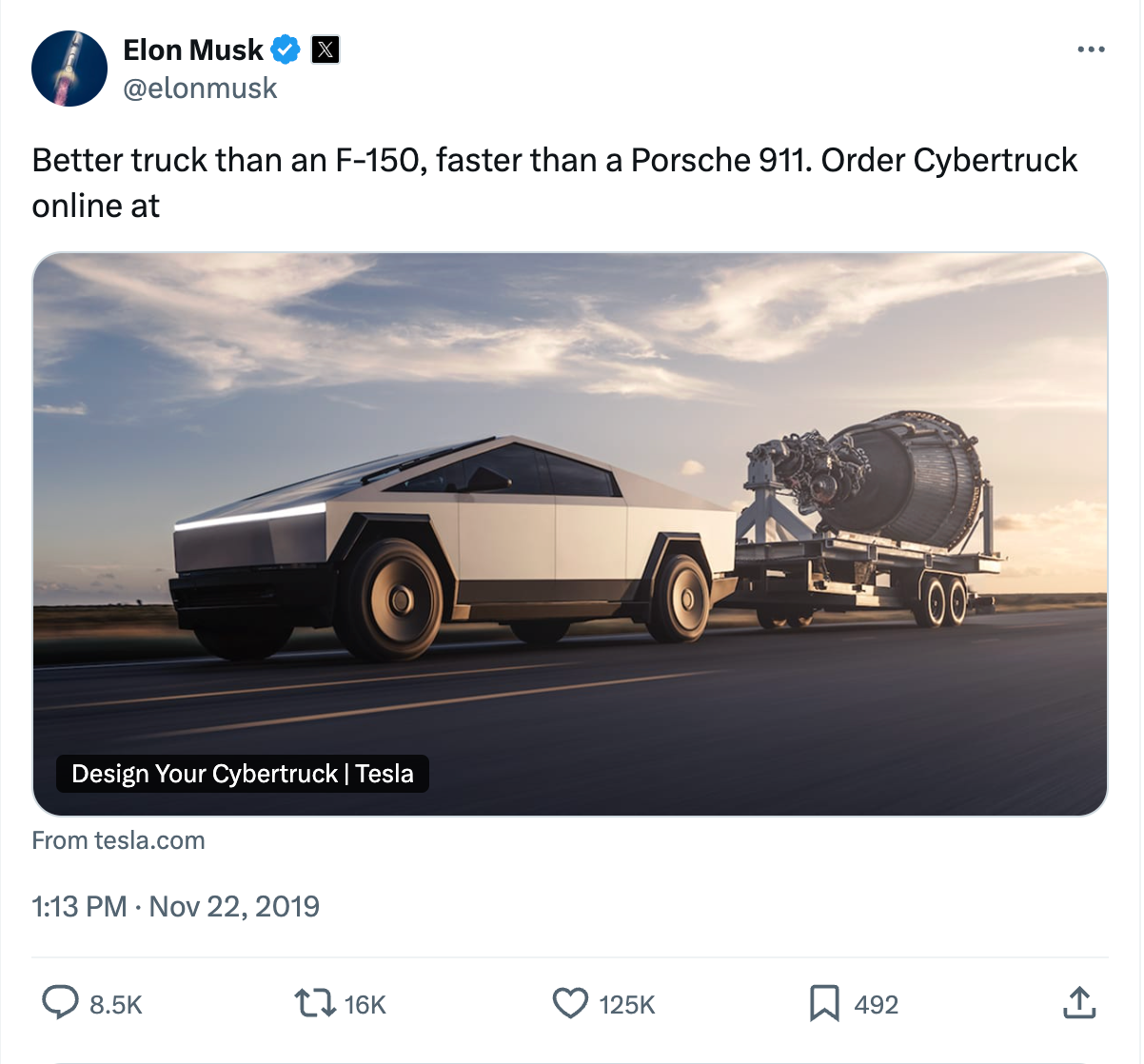
(“Better truck than an F-150, faster than a Porsche 911…”) X (formerly Twitter)+1
Context
When Tesla unveiled the Cybertruck in 2023, the event went viral partly because the “armored glass” demo cracked on stage. Coverage immediately turned into a mix of hype + ridicule.
In the days after, Musk kept posting content to re-steer the narrative toward performance and capability (including comparisons to the F-150).
Analysis
Compression: He collapses a complex product into one repeatable claim.
Borrowed recognition: F-150 = “real truck.” 911 = “real speed.”
Positioning move: Not “an electric pickup,” but “a new class that beats two icons.”
Marketing Strategy
Anchor your offer to two famous reference points.
One competitor sets credibility, the other sets aspiration. When people can repeat it from memory, they can share it.
2) Bitcoin payments: The headline becomes the tweet

(“You can now buy a Tesla with Bitcoin.”) X (formerly Twitter)+1
Context
A month earlier, Tesla disclosed it had bought $1.5B in Bitcoin and signaled it may accept Bitcoin as payment. This tweet was the follow-through that made it “real.” This is a major mainstream-acceptance moment that also moved markets.
Analysis
Behavior change > feature: “You can now buy…” signals action, not opinion.
Newsworthiness: This reads like a press release headline—so media can lift it instantly.
Identity bridging: It merges two tribes (EV believers + crypto believers) into one moment.
Marketing Strategy
If you want traction, announce something that changes what people can do.
Product updates that create a new action (“pay this way,” “access this now,” “we opened this”) travel farther than explanations.
3) “Not a Flamethrower”: Turning a constraint into a joke
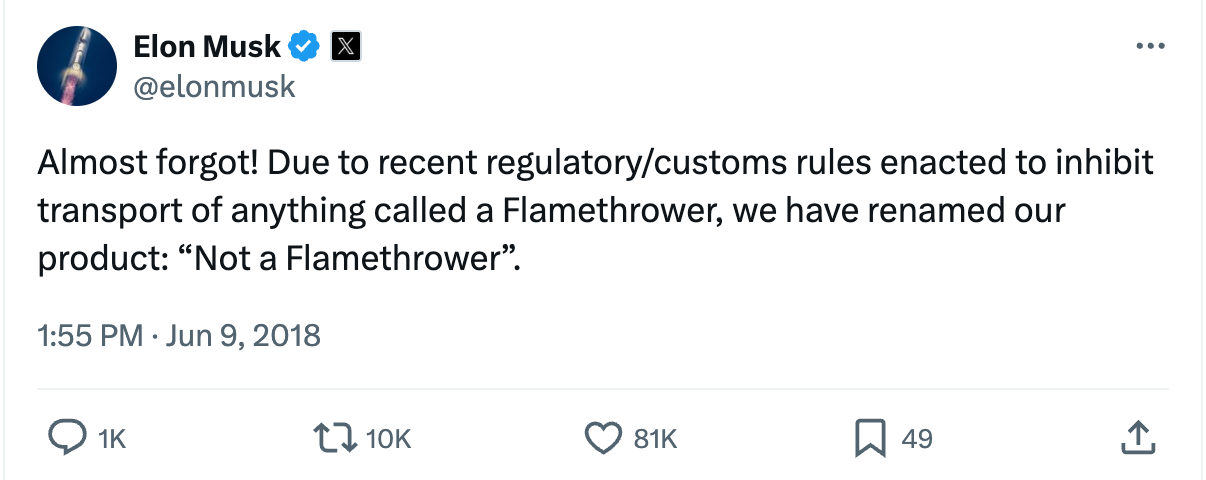
(“Due to regulatory/customs… we have renamed our product: ‘Not a Flamethrower’.”) X (formerly Twitter)
Context
Musk said the rename was driven by regulatory/customs constraints around shipping something called a “flamethrower.” Media coverage at the time framed it as a cheeky workaround. The product created huge publicity and significant revenue for a merch stunt.
Analysis
“Constraint as content”: The limitation becomes the storyline.
Sticky naming: “Not a Flamethrower” is inherently shareable because it’s absurdly specific.
Merch as media: The product is less important than the narrative people repeat.
Marketing Strategy
When something blocks you, publish the workaround… then brand it.
Operational problems (shipping, rules, supply) can become marketing if you turn them into a clean, funny, memorable label.
4) “the bird is freed”: Symbolic messaging that declares a new era

(“the bird is freed”) X (formerly Twitter)+1
Context
This was posted right as he completed the $44B Twitter acquisition. This phrase refers to Twitter’s bird logo and Musk’s stated desire for fewer content limits.
Analysis
Symbol > details: No policy explanation, just a metaphor people instantly understand.
Tribal trigger: It invites supporters to rally and critics to react (both drive reach).
Brand repositioning: It frames the company as “liberated,” not “acquired.”
Marketing Strategy
When you’re changing direction, lead with a symbol – not a memo.
If your audience can feel the shift in one sentence, they’ll spread it for you.
5) “Comedy is now legal on Twitter”: A culture promise (and a fast reality check)
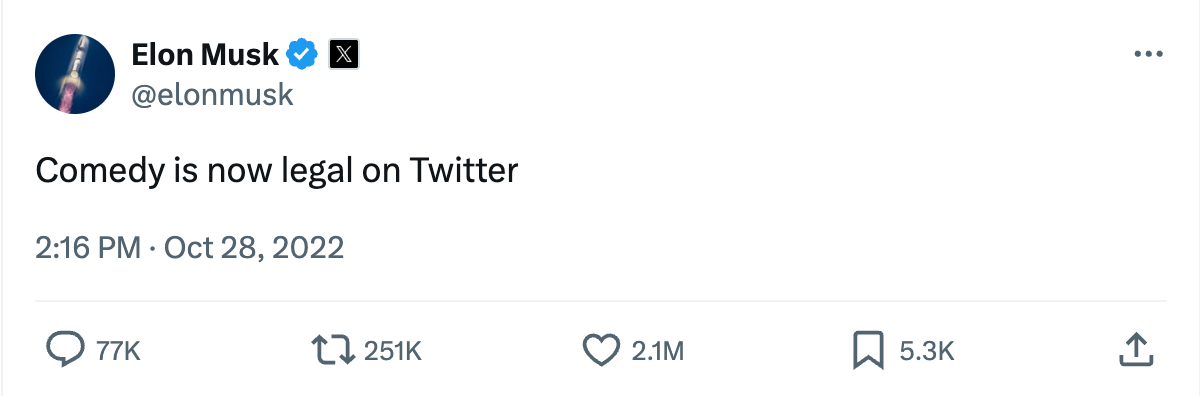
(“Comedy is now legal on Twitter”) X (formerly Twitter)
Context
After this tweet, Musk later posted policies about parody/impersonation needing clear labeling (name + bio), and reporting covered enforcement actions against parody accounts.
Analysis
Culture-setting line: It’s not a product update – it’s a promise about how the place will “feel.”
Attention magnet: “Comedy/legal” is built to spread because it’s provocative and simple.
Credibility risk: Big cultural promises get tested immediately; inconsistency becomes its own story.
Marketing Strategy
If you make a bold cultural claim, back it with consistent rules.
Culture statements (“we’re the fun brand,” “we’re premium,” “we’re for builders”) only work when your actions don’t contradict them.
The 5 Repeatable Mechanics (No Elon Required)
Make one-line positioning claims people can repeat.
Announce behavior changes, not just features.
Turn constraints into branded narratives.
Use symbols to signal a strategic shift.
Match culture promises with consistent enforcement.
Looking Ahead
The bigger takeaway isn’t to post more, It’s that social platforms reward messaging that’s engineered to travel: short, specific, and easy for someone else to repeat without losing the meaning.
As feeds get more crowded and more algorithm-driven, low-traction posts will usually fall into one of two buckets:
They’re too generic (no contrast, no hook, no clear point of view).
They’re too detailed (too much context before the reader understands why they should care).
The next evolution for brands – especially founder-led businesses – is treating social the way Musk does at scale: not as a diary, but as a distribution system. That means building a repeatable “headline style” for your company: a few signature frames, a consistent language pattern, and proof points that reinforce the same narrative over time.
The brands that win attention in 2026 won’t be the loudest. They’ll be the clearest, because clarity is what gets shared.
Summary
Effective leadership communication has shifted from long-form storytelling to distribution-engineered messaging.
In an AI-saturated feed, leaders maximize impact by treating social platforms as distribution systems rather than diaries. This strategy—modeled by high-velocity founders like Elon Musk—prioritizes compressed positioning and repeatable frames over detailed context. By using one-sentence headlines that focus on signal over noise, executives ensure their message survives the scroll-past and remains shareable across platforms.
The core of this strategy involves five repeatable mechanics: anchoring new products to famous reference points, announcing behavior changes instead of feature updates, turning operational constraints into branded narratives, using symbols to signal strategic shifts, and backing cultural promises with consistent action.
To stand out, leaders must avoid the "generic" and the "over-detailed" traps. In 2026, the brands that win attention are those that offer the most clarity, as clarity is the only mechanism that allows a leadership narrative to travel at scale without losing its meaning.
We Can Help
Looking for leadership support? Reach out: hello@ieconsultingcorp.com
